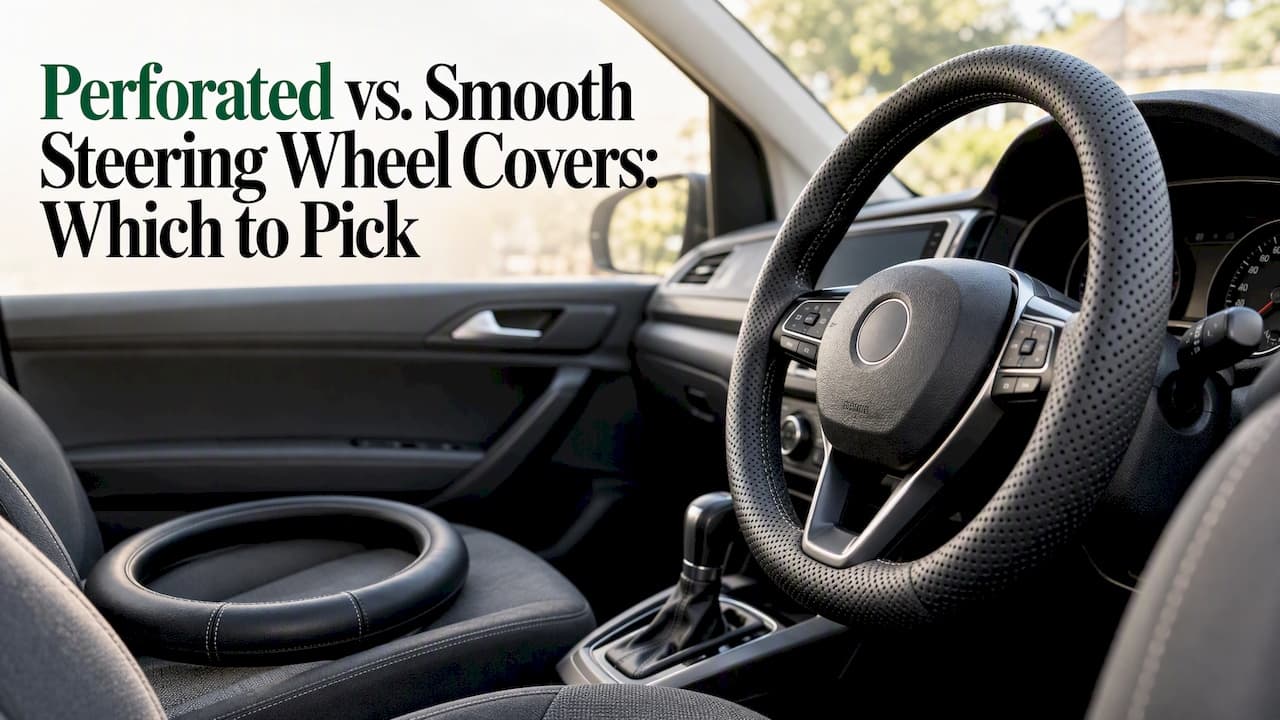
Pick a perforated steering wheel cover if your hands sweat, you drive in a hot climate, or you want a sporty grip. Pick a smooth one if you want a clean look, an easy wipe-down and a softer feel in cool weather. Whichever you choose, fit and friction matter more than texture. A cover that turns on the rim is a hazard, perforated or not.
Below we compare the two on breathability, grip, heat, durability, looks and care. We also cover the textures in between, a fit check you can do in 30 seconds, and what to avoid on a wheel that houses an airbag.
TL;DR
- Perforated covers have small punched holes. They breathe better, feel grippier and suit hot, humid driving and long commutes.
- Smooth covers look cleaner, wipe off easily and feel plush. They can feel slick when your palms are damp.
- Grip comes from the inner lining and the fit, not only the outer surface. Slippage is the main risk of any cover.
- Run the 10 and 2 o'clock twist test after installing. If the cover moves at all, it is too loose to drive with.
- Match the cover to your wheel size. Most universal covers are sized around 14.5 to 15 inches (about 37 to 38 cm).
Table of Contents
- What "perforated" and "smooth" actually mean
- Perforated covers: where they win and where they don't
- Smooth covers: where they win and where they don't
- Side-by-side comparison
- Grip and safety matter more than the surface
- Picking by climate and driving habits
- Beyond the two: braided and knitted covers
- How to install a cover so it stays tight
- Care and cleaning
- Our perspective
- Shop breathable comfort for the driver's seat
- Quick decision guide
- FAQ
- Sources
What "perforated" and "smooth" actually mean
People search for "wheel covers" when they mean the sleeve that goes over the steering wheel, so we will use "steering wheel cover" here. The two terms describe the outer surface only.
Perforated covers have rows of small holes punched through the material, usually on the sides of the grip, sometimes across the whole rim. The material is typically leather, microfiber leather or a synthetic that imitates it. The holes let air and moisture move between your palm and the wheel.
Smooth covers have a continuous surface. That includes sleek faux leather, plain leather, and soft wraps with no cutouts. The surface is uniform, so there is nothing to catch dust or fingernails.
There is a third group worth knowing about: textured covers. Braided, knitted, honeycomb and ribbed designs get their grip from the weave or pattern rather than from holes. They breathe in a different way, because the fabric structure is open. We come back to them below.

Perforated covers: where they win and where they don't
Breathability and sweat
The main reason to buy perforated is heat management. A dark wheel in a parked car in July gets uncomfortable, and a solid surface traps moisture against your palms. Perforation gives sweat somewhere to go and lets the surface dry faster after you wipe your hands on a trouser leg.
That does not mean the wheel stays cool. A perforated cover on a sun-baked wheel is still hot at first. What changes is how clammy it feels once you are driving, and how quickly it dries.
Grip and steering feel
The holes break up the surface, which gives your fingers more to hold. Many perforated designs also pair the holes with a stitched or contoured sport grip. Drivers who hold the wheel firmly at 9 and 3 usually notice the difference on long drives.
Trade-offs
- Dirt in the holes. Skin oil, lotion and dust collect in the perforations over time. A soft brush or a damp microfiber cloth keeps them clean.
- Rougher feel. Some people find the punched edges less pleasant against bare skin, especially in winter when the surface is cold and stiff.
- Style. The look reads sporty. If your interior is plush and formal, it may clash.
Smooth covers: where they win and where they don't
Comfort and appearance
Smooth covers feel soft and look tidy. They blend into most interiors and suit drivers who want the wheel to look like it came that way from the factory. In cool weather, a smooth, padded cover is pleasant to hold and does not feel scratchy.
Cleaning
No holes means nothing to clog. A wipe with a damp cloth usually does it. If you eat in the car, have kids, or use hand sanitizer a lot, this matters more than it sounds.
Trade-offs
- Slick when damp. Sweaty palms, hand lotion or sunscreen can make a glossy surface slippery. This is the biggest practical downside.
- Heat retention. A solid surface holds warmth and moisture, which is a nuisance on hot days.
- Slippage risk depends on the lining. A smooth outside is fine as long as the inside grips the rim. That is a fit question, not a texture question, and we cover it next.
Side-by-side comparison
| Factor | Perforated | Smooth | Textured (braided, knitted, honeycomb) |
|---|---|---|---|
| Breathability | Good | Lower | Good, from the open weave |
| Grip with damp hands | Strong | Can be slick | Strong |
| Feel in cold weather | Can feel stiff | Soft and plush | Warm, fabric-like |
| Cleaning | Needs brushing in holes | Wipe clean | Depends on the fabric |
| Look | Sporty | Factory-clean | Casual or decorative |
| Best for | Hot climates, long commutes | Mixed or cool climates, tidy interiors | Drivers who want grip and personality |
This is our own summary of how the types generally behave, not a lab result. Individual products vary with material and build quality.
Grip and safety matter more than the surface
The holes, the stitching and the finish are cosmetic compared with one question: does the cover stay put? According to a steering wheel cover safety guide, the main risk is the cover rotating independently of the rim during an emergency maneuver. It recommends a textured, rubberized inner lining that provides enough friction to pass your input to the steering column.
So when comparing perforated and smooth, look at the inside first. Check for a rubberized or grippy lining and a snug, even fit around the entire circumference.
The 10 and 2 twist test
The same guide describes a simple check after installation. Grasp the cover at the 10 and 2 o'clock positions and try to twist it toward the dashboard. Any perceptible movement means the cover is unsafe to use and has to be fitted tighter. Do this in the driveway, not on the road.
If a cover fails the test and you cannot make it tight, return it. Do not drive on it hoping it will settle.
Other safety points
- Size. A cover that is too big bunches and slips. One that is too small stretches thin and may split. Measure the outer diameter of your wheel before buying, and note whether it is round or flat-bottomed.
- Thickness. A very thick, padded cover changes how the wheel feels in your hand and makes quick corrections harder. Slim covers keep better steering feedback.
- Nothing over the airbag. NHTSA has warned about decorative emblem decals placed over the center of the wheel, because a deploying airbag can turn the accessory into a projectile. A rim cover sits on the grip, not the hub, but keep any add-on well away from the airbag cover. If you are unsure about your car, check the owner's manual or ask a dealership service department.
- Visibility of the dash. Make sure the cover does not narrow your view of the gauges or interfere with paddle shifters or wheel buttons.
Picking by climate and driving habits
Hot and humid (Florida, Texas, the Southwest): Go perforated or textured. Pair it with a windshield sun shade to keep the wheel from baking while you are parked.
Cold winters (Upper Midwest, Northeast): A smooth, soft cover is more comfortable on a cold start. Perforated leather can feel stiff when the temperature drops.
Mixed climates: Either works. A thin perforated microfiber cover covers the most ground, while a textured weave is a good middle path.
Long commutes or rideshare: Perforated or textured. Hand fatigue and sweat build up over hours.
Short trips, shared cars: Smooth is fine and easier to keep clean when several people drive.
Sweaty or dry hands: If your hands sweat, avoid glossy smooth finishes. If you wear gloves in winter, a smooth or fabric cover works well.

Beyond the two: braided and knitted covers
Perforation is not the only way to get grip and airflow. A braided or knitted cover uses the weave itself for traction, and the fabric is naturally open.
We stock options in this style. The 38CM universal braided grip steering wheel cover is a protective braided design sized for standard 38 cm (about 15 inch) wheels. If you want something more decorative, the daisy flower knitted steering wheel cover adds personality to the cabin while still being a universal fit.
Check the product page for materials and sizing before you order, and run the twist test once installed, as you would with any cover.
How to install a cover so it stays tight
- Park and straighten the wheel. Turn off the engine. Keep the wheels pointed straight ahead.
- Warm the cover. A tight cover is stiff in the cold. A hair dryer on a low setting makes it more pliable. Product guidance for tight-fitting covers suggests warming it and using a second pair of hands, much like mounting a tire. Keep the heat moderate so you do not damage the material.
- Hook the top first. Place the cover over the top of the rim, then work down both sides toward the bottom.
- Stretch the bottom last. Pull the final section over the lowest part of the rim and seat the stitching so it sits evenly.
- Smooth it all around. Run your hands along the whole circumference to remove bunching.
- Do the twist test. Grasp at 10 and 2 and try to turn the cover. No movement means you are good.
- Re-check after a week. Covers can settle slightly. Test again, and tighten or replace if there is any play.
Care and cleaning
- Perforated: Wipe with a damp microfiber cloth, then use a soft brush to lift debris from the holes. Avoid soaking, since moisture trapped under the cover can get into the foam or stitching.
- Smooth: Wipe with a mild soap solution on a cloth and dry. Avoid harsh solvents that can strip the finish.
- Knitted or braided: Follow the care label. Many can be spot cleaned with a gentle cleaner.
- All types: Hand sanitizer and lotion break down some finishes over time, so wipe the wheel now and then.
Our perspective
We sell interior accessories, and steering wheel covers are one of those items where customers tend to focus on the wrong thing. They ask whether to choose holes or no holes, when the first question should be whether the cover will fit and stay put.
Our advice is simple. Start with your wheel size, then your climate, then your taste. For most drivers who spend real time behind the wheel, a breathable surface, either perforated or a textured weave, is the more comfortable everyday choice. A smooth cover is a good fit when appearance and easy cleaning come first.
We built our store around clear product information because accessories should make the drive better and easier, not add a worry. That is why we keep telling people to do the twist test. It takes seconds and it is the single best predictor that a cover is safe to use.
— Bryan
Shop breathable comfort for the driver's seat
If you are setting up your cabin for comfort, browse our Interior Accessories collection for steering wheel covers and other everyday upgrades. Our Most Purchased items page is a quick way to see what other drivers choose. If long drives bother your neck, the memory foam car neck support pillow pairs well with a more comfortable wheel.

Quick decision guide
- You want the coolest-feeling option: perforated or a braided or honeycomb weave.
- You want the cleanest look: smooth, with a rubberized lining.
- Your hands get sweaty: avoid glossy smooth finishes.
- You live where winters are harsh: smooth and soft, or a fabric weave.
- You want to personalize your car: knitted or patterned covers.
- You are unsure about size: measure first, and return any cover that fails the twist test.
For a bigger interior refresh, our guide on choosing the best car floor mats covers the other surface you touch every day.
FAQ
Is a perforated steering wheel cover really more breathable?
Yes, generally. The holes let air and moisture pass between your palms and the wheel, so the surface feels less clammy over time. It will not make a sun-heated wheel cold, but it dries faster and reduces that sticky feeling. Textured weaves such as braided or honeycomb designs also breathe well.
Are steering wheel covers safe?
They can be, if they fit snugly and have a high-friction lining. The main risk is slippage during sudden maneuvers. Do the 10 and 2 o'clock twist test after installing, and do not drive if the cover moves at all. If you have doubts about a specific vehicle, ask a dealership service department.
What is the best material for a breathable steering wheel cover?
Perforated leather or microfiber leather, and open weaves such as braided or knitted fabric, are the common breathable choices. The best one for you depends on your climate and how sensitive your hands are to texture. Whatever the material, look for a grippy inner lining and the right size for your wheel.
Will a smooth cover be slippery?
It can feel slick if your hands are damp or you have lotion or sunscreen on. The cover itself should not rotate if the inside grips the rim and the size is right. If the outer surface feels too glossy, choose a perforated or textured style instead.
Sources
- Are Steering Wheel Covers Safe? Risk vs. Grip Guide, EngineerSkill.blog
- Aftermarket Car "Bling" Continues to Inflict Harm, Safety Research & Strategies